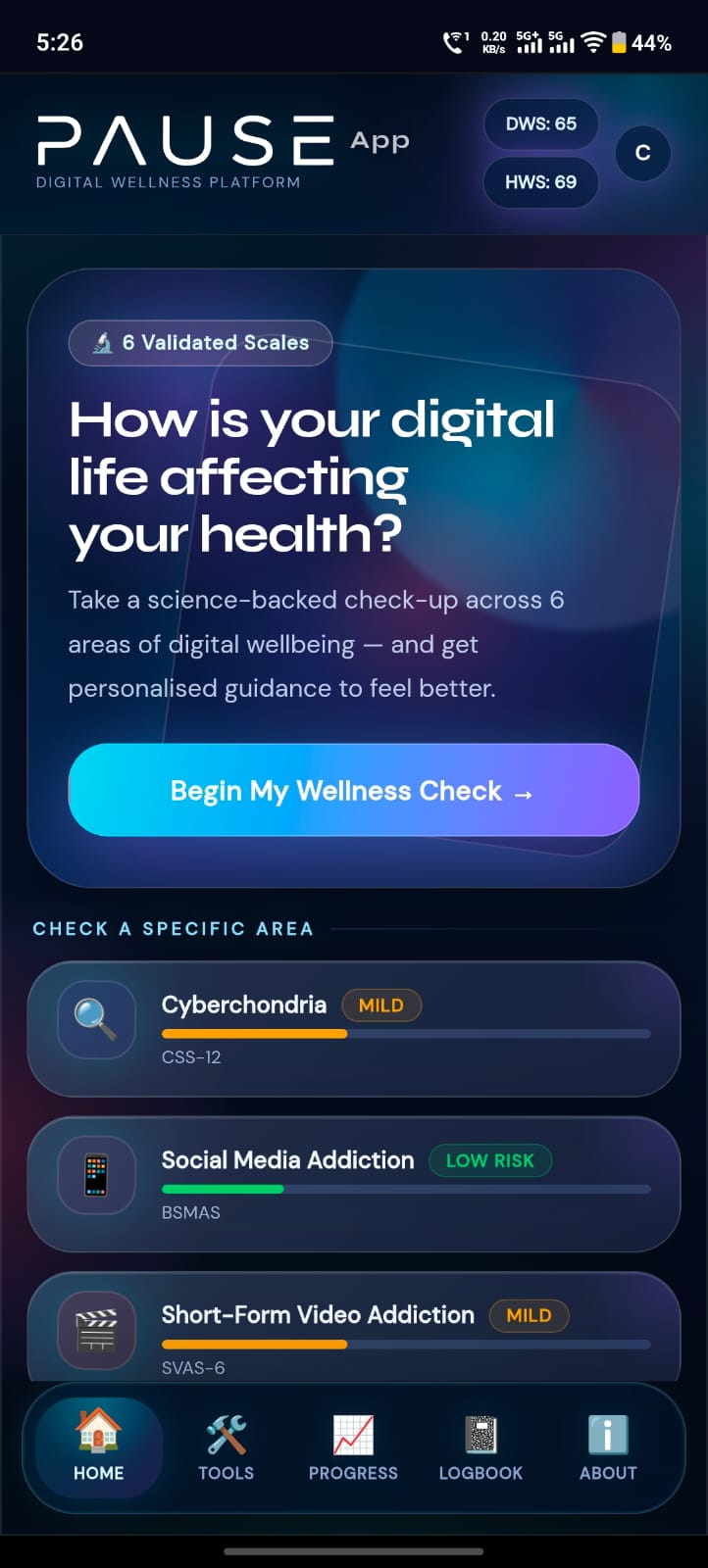
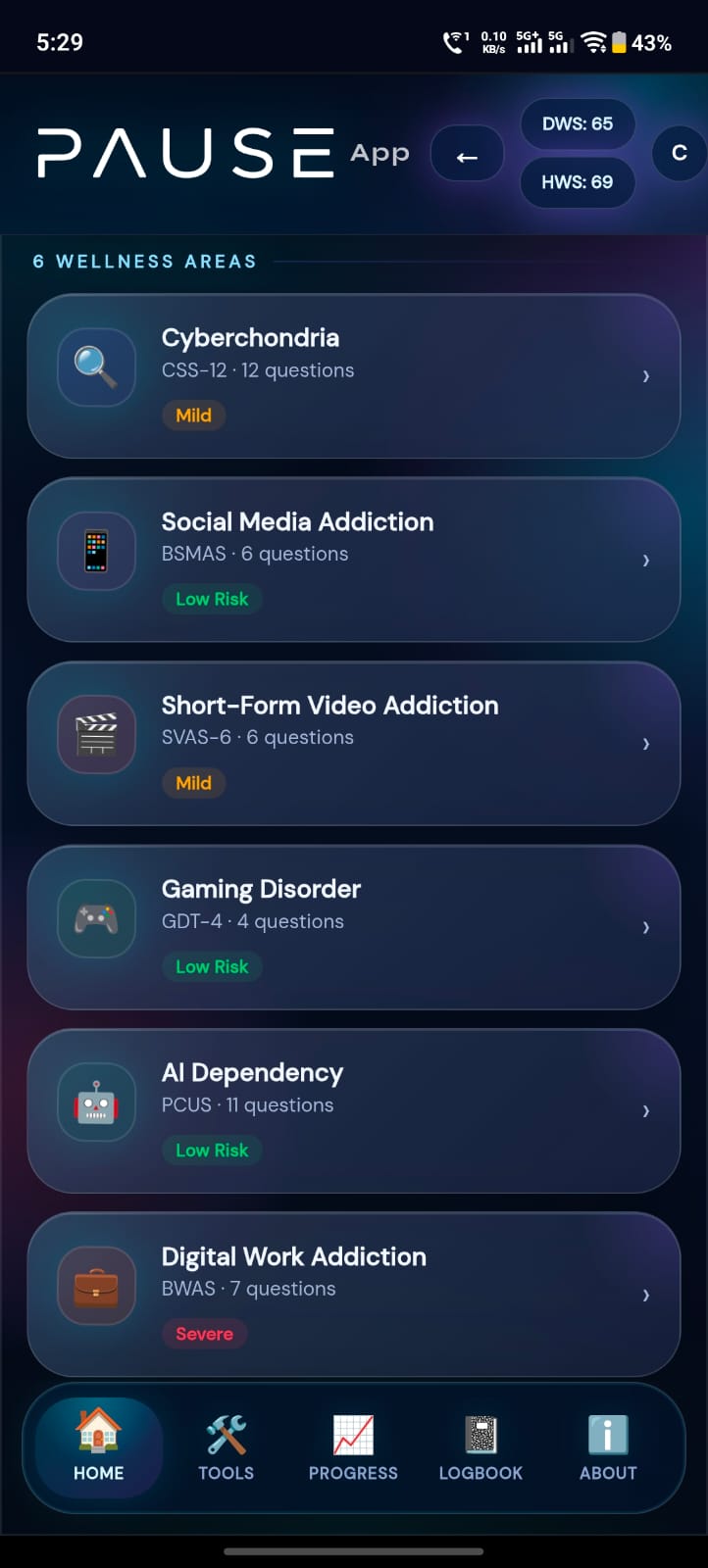
PAUSE is a free Android app that screens six digital use disorders using peer-reviewed clinical instruments — and translates the scores into population-level health metrics designed for community-medicine research.
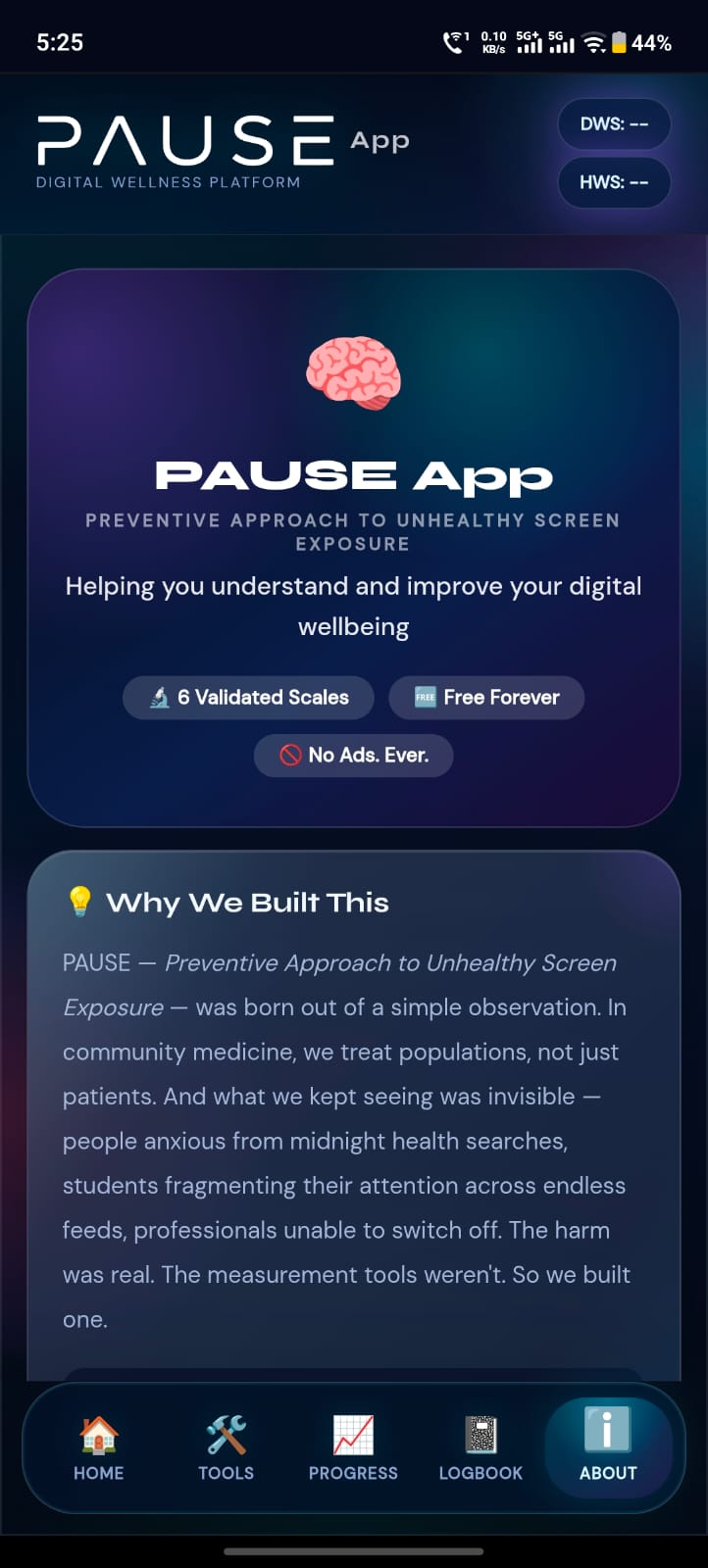
PAUSE — Preventive Approach to Unhealthy Screen Exposure — was born out of a simple observation. In community medicine, we treat populations, not just patients. And what we kept seeing was invisible — people anxious from midnight health searches, students fragmenting their attention across endless feeds, professionals unable to switch off. The harm was real. The measurement tools weren't. So we built one.
Not a tech company. A community medicine department that got tired of watching a problem go unmeasured — and decided to do something about it.
PAUSE doesn't estimate your digital health — it measures it. Every scale used in this app has been peer-reviewed, validated on real populations, and proven to reliably detect genuine disorder.
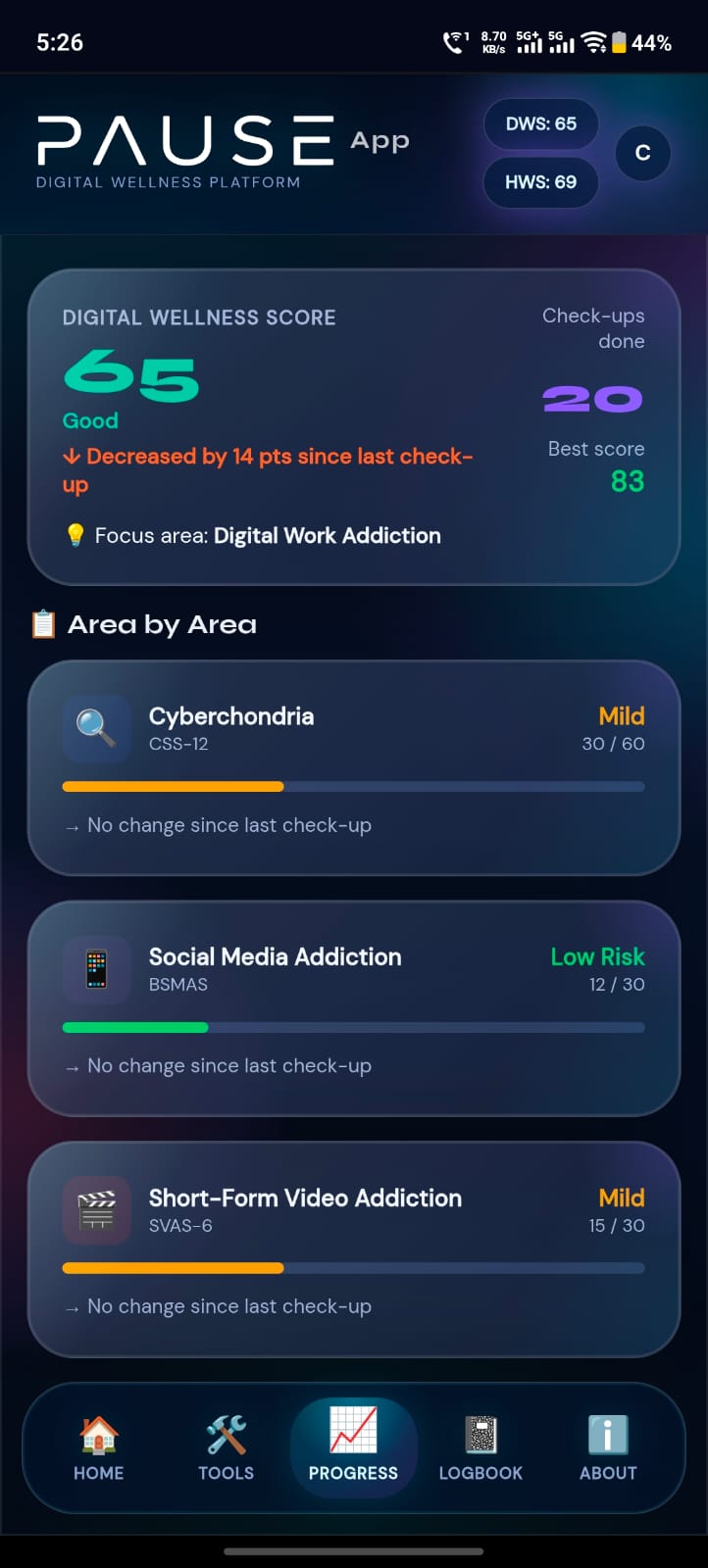
Your Digital Wellness Score (DWS) is a composite of all six instruments, giving you a single number that reflects your overall digital wellbeing — not a guess, not a gimmick, not a wellness vibe-check. A number that means something because the methodology behind it does.
Every disorder in PAUSE is screened with a peer-reviewed, published instrument — not invented questions. Each scale is faithfully reproduced from the validation paper, with severity bands taken directly from the original authors where established, or pragmatically labelled where the published literature has not yet set cut-offs.
Excessive online searching for health information that amplifies, rather than resolves, health anxiety. The 12-item Cyberchondria Severity Scale (short form) measures four sub-domains — compulsion, distress, excessiveness, and reassurance-seeking.
Research note: the PAUSE app uses the short form (CSS-12). Copyright permission obtained from Dr. Eoin McElroy.
Problematic social-media use assessed across the classical six addiction criteria — salience, mood modification, tolerance, withdrawal, conflict, and relapse. One of the most widely cited social-media addiction instruments in academic literature.
Compulsive consumption of short-form video content — TikTok, Instagram Reels, YouTube Shorts. One of the more recently developed instruments in the platform, addressing a behaviour pattern that older addiction scales were not designed to capture.
The four-item Gaming Disorder Test, directly aligned with WHO ICD-11 Gaming Disorder criteria — loss of control, gaming given priority, and continuation despite negative consequences. A brief, clinically rigorous screen.
Problematic ChatGPT Use Scale, adapted (with written permission from the original author) to cover all major AI chatbots — ChatGPT, Gemini, Claude. Single-factor structure, 4-point Likert, 2-week recall window. One of the first instruments built for the AI-assistant era.
The Bergen Work Addiction Scale, applied to digital work contexts — email overload, always-on remote work culture, compulsive online work that displaces rest, hobbies, and recovery. Seven items grounded in established work-addiction theory.
Explicit copyright permission obtained from the scale authors for use of the three non-CC-licensed instruments in PAUSE: Dr. Eoin McElroy for CSS-12, Dr. Petros Galanis for SVAS-6, and Dr. Sen-Chi Yu for PCUS-11. BSMAS, GDT-4, and BWAS are used under their respective public/open-licence terms with full attribution to the original authors.
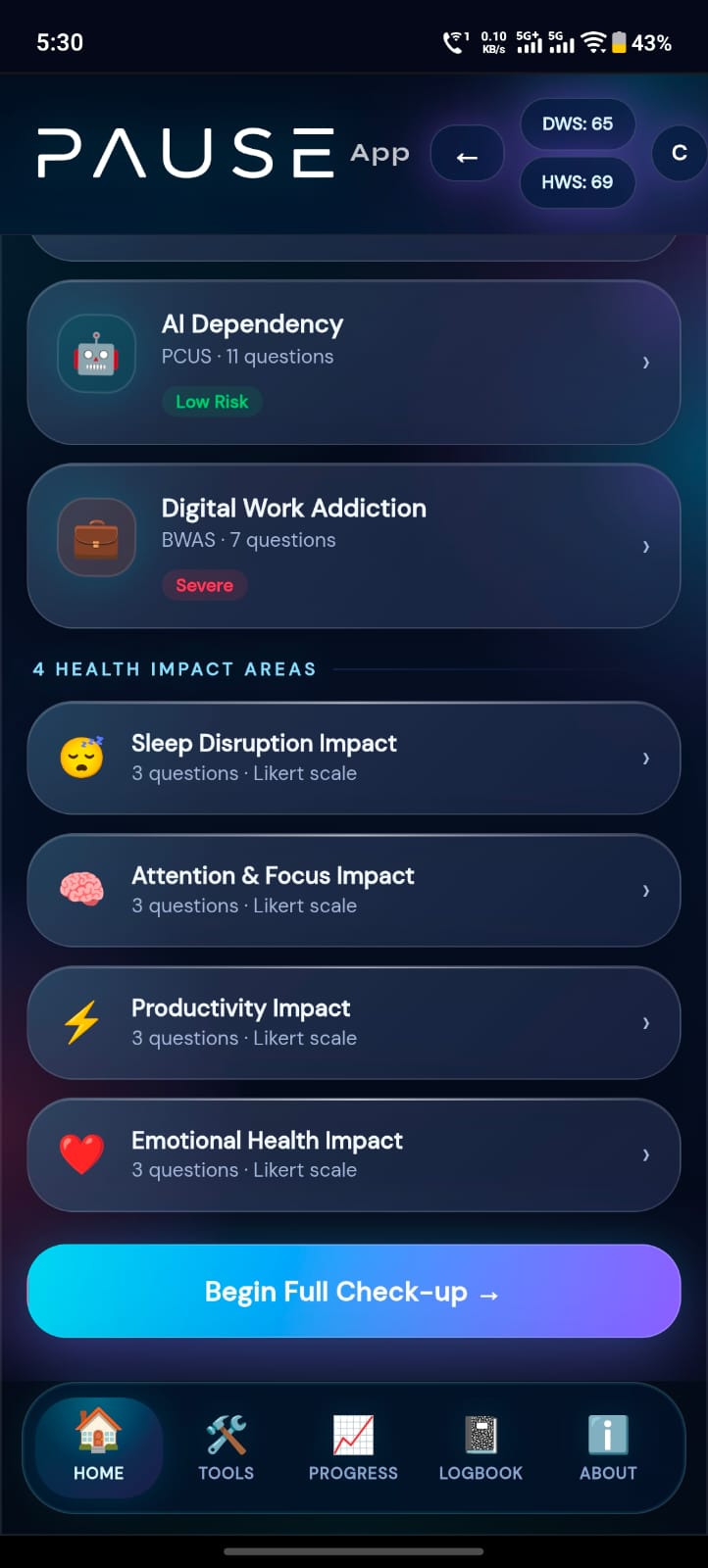
Beyond the six disorders, PAUSE measures the downstream health consequences of digital use across four core impact domains. Each module uses three short Likert-scale items — twelve items in total across the four modules.
PAUSE collapses all measurements into two complementary composite scores. Both run 0–100 where higher is healthier, designed for accessible interpretation by non-clinicians without sacrificing the underlying scale-level granularity.
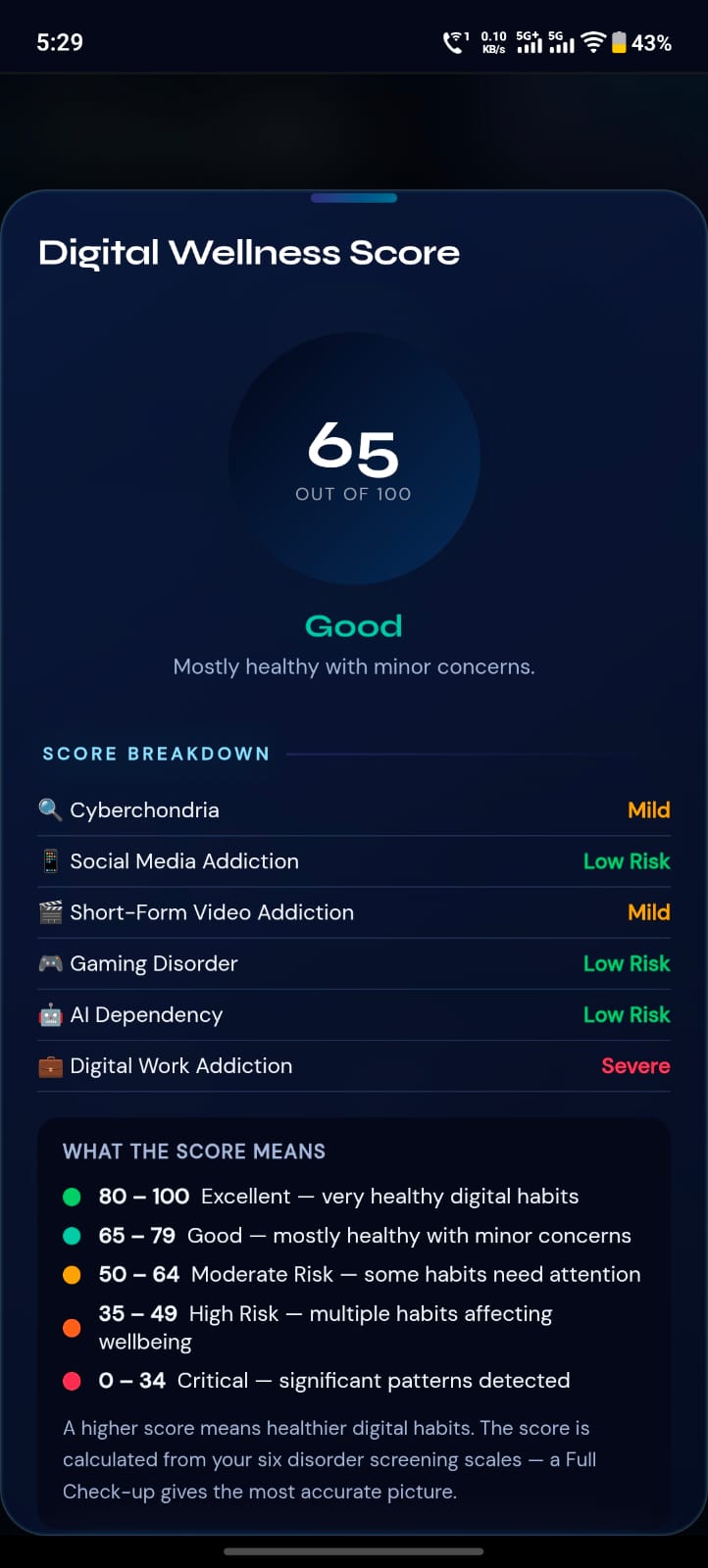
A higher score means healthier digital habits. Bands map composite scores to clear action-oriented guidance — from "very healthy" through "critical patterns detected."
Whether you have a couple of minutes or a full quarter-hour, PAUSE has an assessment mode that matches. Partial-progress resume is built into the Full Check-up so you can stop and continue within a 24-hour window.
All six disorder scales (46 items: CSS-12, BSMAS, SVAS-6, GDT-4, PCUS-11, BWAS) plus the four health-impact modules (12 items in total). Generates both the Digital Wellness Score (DWS) and the Health Wellness Score (HWS), a full area-by-area breakdown, severity classifications, and personalised CBT-based guidance. Resumable if you stop midway.
Just one scale — for when you already suspect a specific area (gaming, social media, AI use, cyberchondria, etc.) and want a focused screen. Updates that disorder's score without re-running the others.
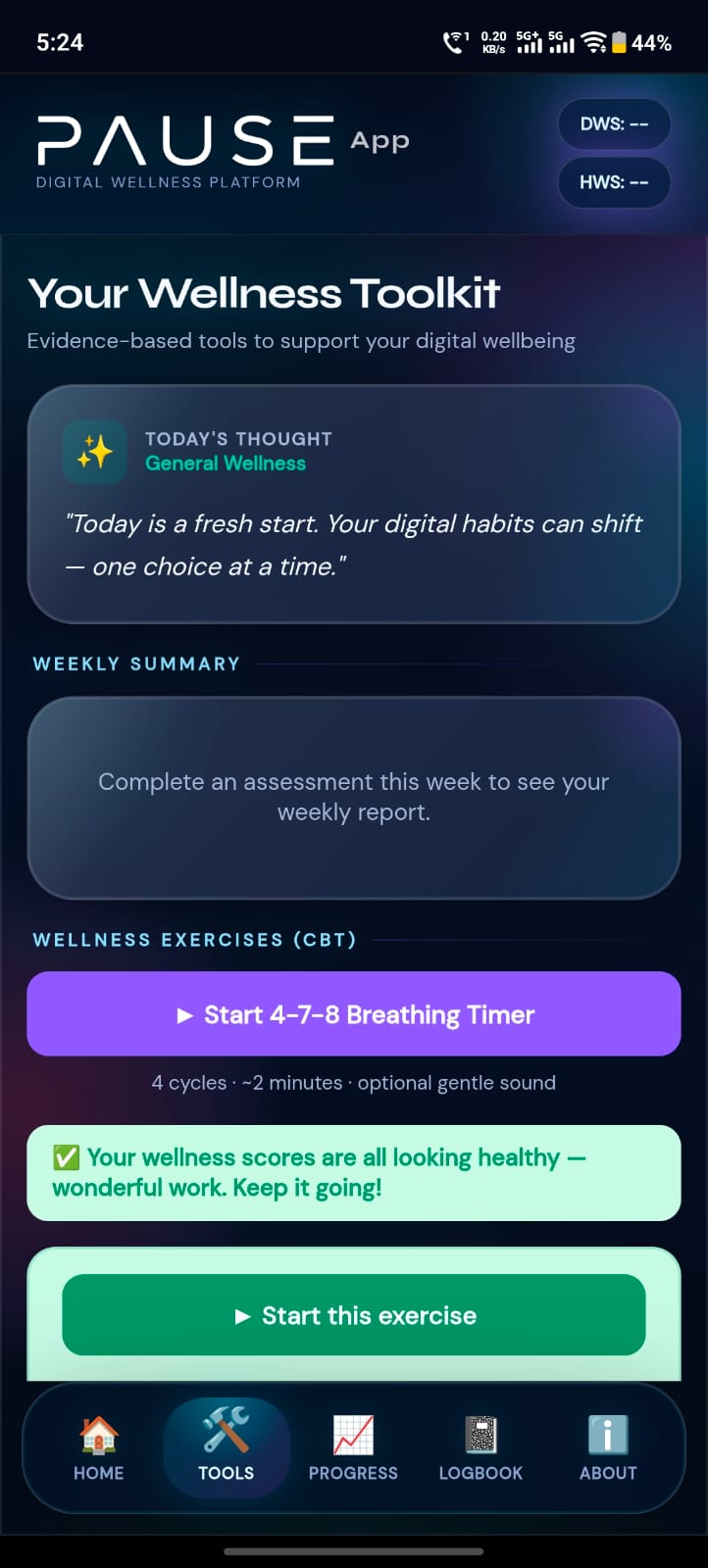
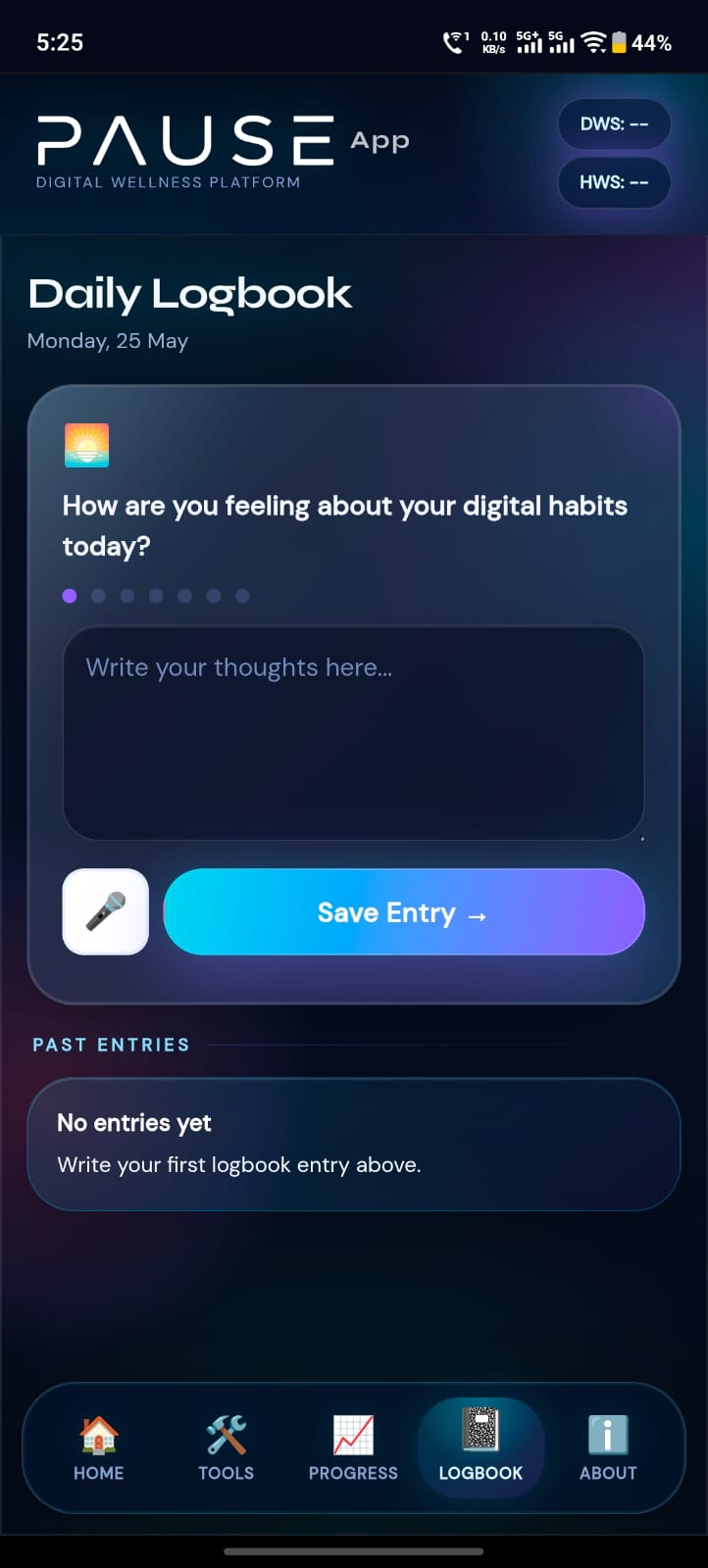
PAUSE is more than a screener — it is a complete digital-wellness platform with assessment, intervention, self-reflection, and progress tracking integrated end-to-end.
After every check-up, PAUSE generates a results page that opens with a single composite number, followed by clear interpretation, then drills down into each disorder's individual severity classification — so users can see at a glance which area needs attention.
The result screen also embeds a five-band reference table, so the score doesn't sit in a vacuum. Users immediately know what 65 means relative to 35 — without needing to memorise cut-offs or consult an external manual.
Two people can have identical social-media addiction scores and very different sleep, focus, and emotional health. PAUSE separates the behaviour (six disorder scales) from the impact (four health modules) so the same behaviour can be tracked across people with different downstream consequences.
For research, this design supports both prevalence work (behaviour distributions) and intervention work (does reducing the behaviour improve the impact?).
Behaviour-change tools work better when users come back. PAUSE includes a lightweight gamification layer — nine non-monetary achievement badges that reward consistent self-screening, full check-up completion, score improvement, and engagement with the 7-day Detox Challenge.
PAUSE is engineered as a Progressive Web App with an Android Trusted Web Activity wrapper — one codebase serves the web, mobile browsers, and the Play Store listing. Backend syncing is optional; the app works fully offline against local storage.
17-module single-page app with no framework or build step. Service worker enables full offline use after the first load. Renders responsively from 360 px upward.
Signed Android App Bundle on Google Play Store. Same web app installable directly via "Add to Home Screen" on iOS and Android browsers — without going through any store.
Local-first storage with optional cloud sync via Supabase Postgres. Users can choose to use PAUSE fully offline with zero account creation, or sync results across devices.
PAUSE grew out of active research in cyberchondria, problematic digital use, and AI-assisted health information seeking among medical students. The CSS-12 instrument anchors two peer-reviewed longitudinal cohort studies currently under review.
The app is built to function not just as a personal self-check, but as a data-collection and screening tool for community-medicine research in low-resource settings — where validated digital instruments are rarely available in a single accessible package.
See research outputPAUSE is a Progressive Web App. On iOS, open the web version in Safari and use Share → Add to Home Screen — it installs as a standalone app icon, launches full-screen, and works offline just like a native app. No App Store account required.